


When discussing evolutionary theory and the origin of new species, many people often think of the finches of the Galápagos Islands, a classic case study that explains adaptation, natural selection, and speciation.
However, in reality, Thailand also possesses a clear and complete example of speciation that is just as compelling.
That example is the emerald snail (Amphidromus classiarius) of Tachai Island—a small creature that hides a remarkable evolutionary story within the forests of the Andaman Sea.
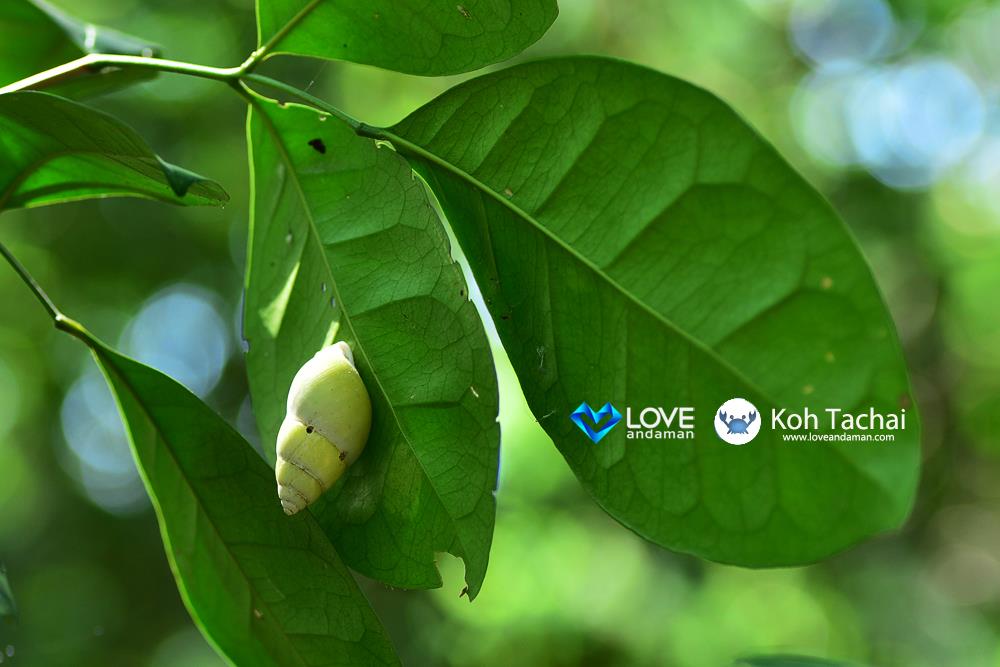
Table of Contents
What Is Amphidromus?
Amphidromus is a genus of arboreal land snails (tree-dwelling snails) found throughout Southeast Asia.
Snails in this genus are well known for their bright and diverse shell colors, especially green and yellow, often with patterns that resemble natural gemstones.
A key characteristic of Amphidromus is that:
Within a single population, both right-coiling and left-coiling shells can be found.
This unusual trait lies at the heart of their evolutionary significance.
Shell Coiling and Survival
In the rainforests of Southeast Asia, several species of snail-eating snakes have evolved teeth that are highly effective at extracting right-coiling snails from their shells.
However, when these snakes encounter left-coiling snails, the structure of their jaws and teeth becomes far less efficient.
As a result:
- Right-coiling snails are preyed upon more frequently
- Left-coiling snails have a higher chance of survival
- Left-coiling traits are passed on more successfully to future generations
This process is a clear example of natural selection at work.
From Adaptation to Speciation: The Emerald Snail of Tachai Island
On the Southeast Asian mainland, a close relative of the emerald snail still exists:
Amphidromus atricallosus,
which contains both left- and right-coiling individuals and is able to interbreed normally.
In the past, rising sea levels caused Tachai Island to become isolated from the mainland.
As a result, some populations of Amphidromus were cut off and forced to survive independently on the island.
On Tachai Island, these snails faced:
- Limited food resources
- Strong predation pressure from snail-eating snakes
- Environmental conditions different from the mainland
Over time:
- Right-coiling snails gradually declined and disappeared
- Only left-coiling snails remained
- Body size became smaller
- Tooth structure and reproductive organs changed
Eventually, this island population could no longer interbreed with mainland snails, meaning a new species had fully formed.
This new species is known as Amphidromus classiarius, commonly called the emerald snail of Tachai Island.
Scientific Importance of the Emerald Snail
The emerald snail is not merely a rare and beautiful green snail—it is also:
- A clear example of speciation
- Evidence of predator-driven evolution
- A complete case study involving physical traits, behavior, and reproduction
- One of the most well-documented evolutionary case studies in Thailand
Conservation: Protecting a Living Record of Evolution
Because the emerald snail is found only on Tachai Island, it is extremely vulnerable.
Disturbance to the forest—such as trampling, collection, or environmental change—could cause its population to decline rapidly.
Protecting Tachai Island is therefore not just about preserving a beautiful tourist destination,
but about safeguarding a living lesson in evolution for future generations.
How is the emerald snail different from other snails?
The emerald snail is an arboreal land snail with a distinctive green shell and is endemic to Tachai Island, making it a fully evolved species found nowhere else in the world.
Is the emerald snail a marine snail?
No. The emerald snail is a land snail that lives in forest environments, not in the sea or coral reefs.
Where can emerald snails be found?
Emerald snails are found only in forested areas on Tachai Island.
Why do all emerald snails have left-coiling shells?
Because left-coiling shells make emerald snails less vulnerable to predators, especially snail-eating snakes. This gives them a higher chance of survival, allowing this trait to be naturally selected and remain dominant within the population.